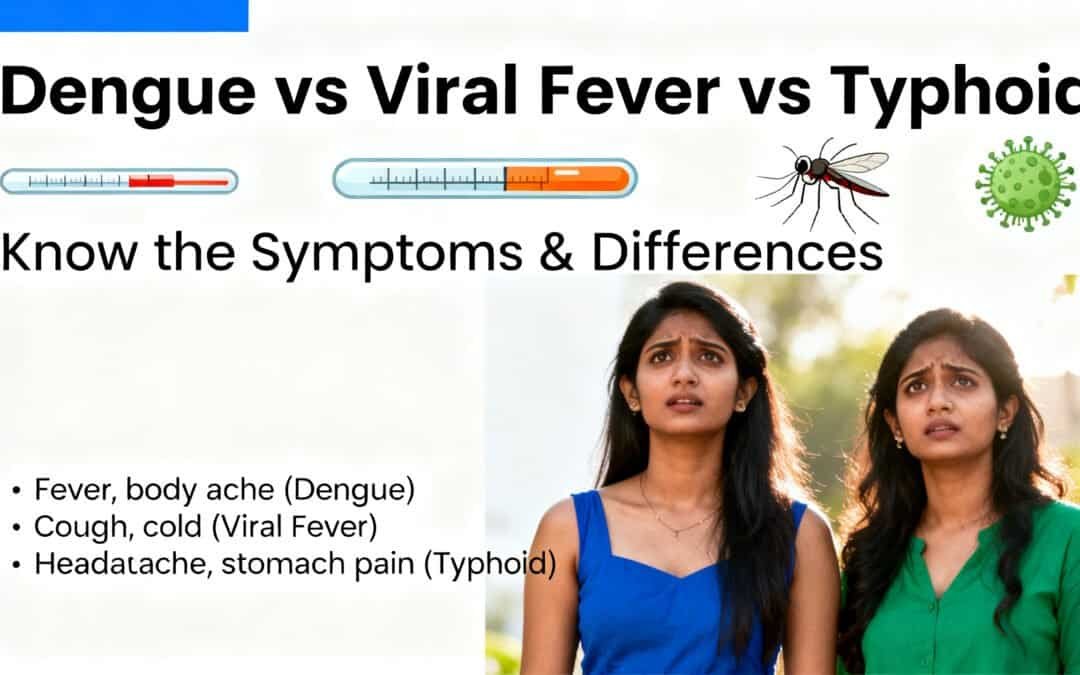
Dengue, viral fever, and typhoid all start with high fever — but they are caused by different things, need different tests, and require different treatment. In Hyderabad’s monsoon season, malaria and chikungunya are also in the mix, each with overlapping symptoms. Knowing the key differences can help you act faster, get the right test, and avoid dangerous complications from delayed or wrong treatment.
This guide from Dr. Ram Kumar at Boston Diabetes, Gachibowli covers the clinical differences between the five most common monsoon fevers in Hyderabad, the right blood tests for each, and when to seek emergency care rather than waiting at home.
Quick Comparison: Dengue vs Viral Fever vs Typhoid vs Malaria vs Chikungunya
| Feature | Dengue | Viral Fever | Typhoid | Malaria | Chikungunya |
|---|---|---|---|---|---|
| Cause | Dengue virus (Aedes mosquito) | Various viruses (airborne) | Salmonella typhi (food/water) | Plasmodium parasite (Anopheles mosquito) | Chikungunya virus (Aedes mosquito) |
| Fever onset | Sudden, very high (39–40°C) | Gradual or sudden, mild to moderate | Gradually rises over 3–5 days | Cyclical — spikes then breaks; every 48–72 hrs | Sudden, high (39–40°C) |
| Joint/muscle pain | Severe generalised “breakbone” pain | Mild to moderate | Mild | Moderate — back, limbs | Severe bilateral small joint pain (defining feature) |
| Headache | Severe, behind the eyes | Mild | Mild to moderate | Moderate — frontal | Moderate |
| Stomach symptoms | Nausea, vomiting | Mild nausea | Stomach pain, constipation or diarrhoea, coated tongue | Nausea, vomiting with the fever spike | Mild nausea |
| Rash | Red rash, Day 3–5 (50–80%) | Usually none | Rare rose-coloured spots | None | Widespread maculopapular rash, may itch |
| Key distinguishing sign | Platelet drop; retro-orbital eye pain | Upper respiratory symptoms | Gradual onset; coated tongue; sustained high fever | Cyclical fever pattern; rigors; splenomegaly | Severe symmetrical small joint arthritis persisting after fever |
| Duration | 7–10 days | 3–7 days | 2–4 weeks if untreated | Recurring episodes if untreated | Fever 3–7 days; joint pain weeks to months |
| Key blood test | NS1 antigen (Day 1–5); Dengue IgM (after Day 5); CBC | CBC (normal or mildly abnormal) | Blood culture (gold standard); Widal; Typhidot IgM | Malaria RDT or peripheral blood smear | Chikungunya IgM (from Day 5); dengue NS1 to exclude co-infection |
| Treatment | Supportive: paracetamol only, fluids, rest | Supportive: rest, fluids, paracetamol | Azithromycin (first-line); ceftriaxone for severe | Chloroquine or artemisinin-based combination; primaquine for P. vivax | Supportive; NSAIDs after dengue excluded; hydroxychloroquine for persistent arthritis |
Dengue Fever — The Most Dangerous Monsoon Illness in Hyderabad
What is dengue?
Dengue is caused by the dengue virus, transmitted exclusively by the Aedes aegypti mosquito. This mosquito bites during the day — particularly in early morning (6–10 AM) and late afternoon (4–7 PM) — and breeds in small amounts of clean, stagnant water: flower pot trays, water cooler reservoirs, overhead tank lids, discarded containers, and coconut shells. In Gachibowli and Nanakramguda, construction sites and open plots with accumulated rainwater are significant breeding sites during the July–October monsoon.
Dengue Symptoms
- Sudden high fever — 39–40°C, onset within hours
- Severe headache — particularly pain behind and around the eyes (retro-orbital), worsened by eye movement
- “Breakbone” pain — intense muscle and joint pain throughout the body; the name “breakbone fever” reflects the severity
- Rash — flat red rash appearing Day 3–5; present in 50–80% of patients; not all dengue patients develop a rash
- Nausea and vomiting
- Profound fatigue — can persist for weeks after recovery
⚠️ The Dengue Critical Phase — Day 4–5 Is When Danger Peaks
This is the most important piece of dengue knowledge that most patients do not have: the fever breaking on Day 4–5 does NOT mean you are recovering. This is when dengue becomes most dangerous.
The first 3 days of dengue are the “febrile phase” — the fever is present, the patient feels very unwell, but the platelet count is still reasonable. Around Day 4–5, the fever breaks and patients feel somewhat better. This is the “critical phase” — and it is when the platelet count crashes most rapidly and plasma leaks from blood vessels, causing the complications of dengue:
- Platelet count may fall from 1,50,000 to below 20,000 within 24–48 hours
- Plasma leakage causes concentrated blood, reduced blood pressure, and shock
- Bleeding — gum bleeding, blood in urine or stool, petechiae (tiny red spots under skin)
- Severe abdominal pain from leaking fluid around abdominal organs
Patients who go home on Day 4 feeling better because “the fever broke” are at the highest risk. CBC monitoring must continue on Day 4, 5, and 6 even if the patient feels better, because this is when the platelet count is most likely to fall precipitously.
⚠️ Emergency Signs — Come to Hospital Immediately
- Bleeding from gums or nose
- Blood in urine, vomit (coffee grounds appearance), or stool (red or black tarry stool)
- Tiny red or purple spots under the skin (petechiae or purpura)
- Severe stomach pain or abdominal tenderness
- Persistent vomiting (3 or more times in a day, or cannot keep fluids down)
- Rapid breathing or difficulty breathing
- Sudden drop in fever with pale, cold, and clammy skin — a sign of shock, not recovery
- Extreme restlessness, confusion, or loss of consciousness
Which Tests for Dengue?
- NS1 antigen test — most reliable in the first 1–5 days; detects the dengue virus protein directly; the first-choice test when dengue is suspected in the early illness
- Dengue IgM/IgG antibody test — used from Day 5 onwards; IgM is positive in current/recent infection
- Complete Blood Count (CBC) — low platelet count (below 1,00,000 per microlitre) and low white blood cell count (leucopenia) together strongly suggest dengue. Monitor daily once platelet count begins falling.
Get tested on Day 2 or 3 if you suspect dengue — do not wait. Early diagnosis enables daily monitoring during the critical phase. Full guide: Dengue Fever Treatment in Gachibowli.
Dengue Treatment
- Paracetamol only for fever and pain — ibuprofen, aspirin, diclofenac, and mefenamic acid all inhibit platelet function and significantly worsen dengue bleeding risk. These must not be taken during the dengue illness.
- 2–3 litres of fluid daily — ORS, coconut water, nimbu pani, soups, buttermilk
- Light, easily digestible food: khichdi, curd rice, dal water, fruits
- Daily CBC monitoring when platelets are below 1,00,000
- Rest completely — avoid exertion until platelets normalise and full recovery confirmed
Viral Fever — The Most Common Monsoon Illness
“Viral fever” is not a single disease — it is an umbrella term for any fever caused by a viral infection that doesn’t have the specific features of dengue, chikungunya, or malaria. Common causes during Hyderabad’s monsoon: influenza (flu), adenovirus, parainfluenza. It spreads through coughing, sneezing, and close contact in schools, offices, and public transport.
Typical symptoms: Fever (38–39°C, rarely as high as dengue), runny nose, sore throat, mild cough, mild body aches, fatigue, and watery eyes. Upper respiratory symptoms (runny nose, sore throat, cough) are characteristic of viral fever and are absent or minimal in dengue and typhoid.
Duration: 3–7 days with rest, fluids, and paracetamol. If fever continues beyond 7 days, or returns after initially settling (“saddle-back” pattern), or is accompanied by severe headache, rash, stomach pain, or intense joint pain — it is not a simple viral fever. Get a CBC and NS1 test.
Antibiotics have no effect on viral fever — they should not be taken unless a doctor has confirmed a bacterial infection. Antibiotic use for viral fever contributes to antibiotic resistance without any benefit.
Full guide: Viral Fever Treatment in Gachibowli.
Typhoid — The Gradual Fever That Needs Antibiotics
Typhoid is a bacterial infection from Salmonella typhi, spread through food and water contaminated by an infected person’s faeces — the “faecal-oral route.” Typhoid does not spread through coughing or touch. During Hyderabad’s monsoon, flooding can contaminate drinking water pipelines with sewage, significantly raising typhoid risk across the city.
Typhoid Symptoms — Week by Week
Week 1: Gradually rising fever — typically starts at 99–100°F, rises to 103–104°F by end of week. Headache, fatigue, and loss of appetite. The gradual onset (unlike dengue’s sudden onset) is a distinguishing feature.
Week 2: Sustained high fever that stays elevated throughout the day — unlike malaria which spikes and then breaks. Stomach pain or abdominal tenderness. Constipation in adults (more common) or diarrhoea in children. A thick white or yellow coating on the tongue is a characteristic sign. Relative bradycardia — pulse rate that is lower than expected for the degree of fever — is a clinical clue to typhoid.
Week 3 (if untreated): Risk of life-threatening complications including intestinal perforation (a surgical emergency), internal bleeding, and encephalopathy. Typhoid caught in Week 1 or 2 responds well to oral antibiotics and resolves completely. Do not let it reach Week 3.
Tests for Typhoid
- Blood culture — the gold standard; most accurate in the first week; identifies the exact organism; results take 48–72 hours but confirms the diagnosis definitively
- Typhidot IgM rapid test — faster turnaround; positive from Day 4–5 onwards; preferred over Widal at Boston Diabetes for initial diagnosis
- Widal test — widely available but has significant limitations in India: false positives are common in previously vaccinated individuals and in other febrile illnesses; a positive Widal alone is not diagnostic; the titre must be high (above 1:160) and rising, and should always be interpreted alongside the clinical picture. A Widal test result should not be the sole basis for starting typhoid antibiotics.
Typhoid Treatment
Typhoid requires antibiotics — it does not resolve without treatment. In India, ciprofloxacin resistance now exceeds 80%, making it ineffective for most typhoid cases. Azithromycin 500mg–1g daily for 5–7 days is the current first-line treatment for uncomplicated typhoid in Hyderabad. Intravenous ceftriaxone is used for severe or hospitalised cases. Complete the full course even if you feel better after 2–3 days — stopping early causes relapse and resistance. Full guide: Typhoid Treatment in Gachibowli.
Malaria — The Cyclical Fever That Needs a Smear Test
Malaria is caused by Plasmodium parasites (most commonly P. vivax in Hyderabad) transmitted by the night-biting Anopheles mosquito — distinct from the day-biting Aedes that transmits dengue and chikungunya. Malaria cases in Hyderabad are concentrated in low-lying areas with stagnant water near construction sites, drainage channels, and open fields.
The cyclical fever pattern is the key distinguishing feature: fever comes in paroxysms — a sudden chill and rigors (uncontrollable shaking), followed by a rapid high fever (40–41°C), followed by profuse sweating as the fever breaks, then complete recovery until the next cycle. In P. vivax malaria, cycles occur approximately every 48 hours. Between the cycles, the patient may feel almost normal — which is distinctly different from dengue or typhoid where the patient feels constantly unwell.
Other features: anaemia (the parasite destroys red blood cells), enlarged spleen (splenomegaly), headache, and vomiting with each fever episode.
Tests: Malaria Rapid Diagnostic Test (RDT) or peripheral blood smear (most accurate — identifies the Plasmodium species). Blood smears should be taken during or just after a fever episode for highest sensitivity.
Treatment: Chloroquine (for chloroquine-sensitive P. vivax) or artemisinin-based combination therapy (for P. falciparum or chloroquine-resistant P. vivax). Critically, P. vivax malaria also requires primaquine 14-day radical cure to eliminate the dormant liver stage (hypnozoites) that causes relapse. G6PD enzyme testing must be done before primaquine — primaquine causes severe haemolysis in G6PD-deficient patients.
Chikungunya — When the Joints Remain Painful After the Fever
Chikungunya is transmitted by the same Aedes aegypti mosquito as dengue and therefore occurs in the same season in the same neighbourhoods. Co-infection with both dengue and chikungunya simultaneously is documented.
The key distinguishing feature: severe, bilateral, symmetrical small joint arthritis — pain in the small joints of the hands (knuckles, wrists), feet, and ankles that is so severe patients cannot make a fist, open a jar, or walk normally. This level of specific joint involvement is not seen in dengue, viral fever, or typhoid. The second distinguishing feature: the joint pain persists for weeks to months after the fever resolves — in 30–40% of patients, significant joint pain continues at 3 months.
The initial NSAID restriction: In the first 3–5 days of a monsoon fever with joint pain, avoid NSAIDs (ibuprofen, diclofenac) until dengue co-infection is excluded — NSAIDs increase dengue bleeding risk. Once a negative NS1 test and normal CBC confirm dengue is unlikely, NSAIDs are appropriate for chikungunya joint pain management. Hydroxychloroquine for joint symptoms persisting beyond 4–6 weeks.
Full guide: Chikungunya Treatment in Gachibowli.
The Right Blood Test for Each Fever — At Boston Diabetes
Dr. Ram Kumar’s approach to a fever patient during monsoon season in Gachibowli:
- History and examination first: onset pattern (sudden = dengue/chikungunya; gradual = typhoid; cyclical = malaria), joint pain character, eye pain, stomach symptoms, bleeding signs, cough/runny nose (suggests viral fever)
- CBC (Complete Blood Count): low platelets + low WBC strongly suggests dengue; anaemia + normal WBC suggests malaria; high WBC may suggest bacterial infection (typhoid, secondary bacterial infection)
- NS1 antigen test: for any sudden-onset monsoon fever in Days 1–5; most important first test
- Malaria RDT or smear: if cyclical fever pattern; if from high-risk area; if patient does not respond to initial management
- Typhidot IgM: if gradual-onset fever with stomach symptoms persisting beyond Day 4
- Blood culture: for suspected typhoid (most specific test)
- Chikungunya IgM: if severe bilateral joint pain after dengue excluded
Prevention During Hyderabad Monsoon 2026
All five monsoon illnesses are preventable with appropriate measures:
- Dengue and chikungunya: eliminate Aedes mosquito breeding sites — empty cooler trays weekly, cover water storage containers, check for stagnant water in flower pots, old tyres, and open drains; use daytime mosquito repellent (DEET or picaridin-based); full-sleeve clothing during 6–10 AM and 4–7 PM
- Malaria: long-sleeved clothing and DEET repellent in the evening; mosquito nets; eliminate stagnant water around the home
- Typhoid: drink only boiled or well-filtered water; thorough handwashing before every meal; avoid street food and raw cut fruit during monsoon; the Typbar TCV typhoid conjugate vaccine provides 5-year protection — ask Dr. Ram Kumar if you are due for vaccination
- Viral fever: influenza vaccine available at Boston Diabetes; handwashing; avoid close contact with sick individuals; avoid touching face in public
See the complete monsoon disease guide: 7 Monsoon Diseases Rising in Hyderabad Right Now.
When to See a Doctor — Do Not Wait
Many patients in Gachibowli wait 4–5 days at home hoping the fever will pass. Come to Boston Diabetes promptly if:
- Fever lasts more than 3 days
- Temperature above 39°C (102°F)
- Severe headache, pain behind the eyes, or intense joint pain
- Any rash appearing on the body
- Stomach pain or repeated vomiting alongside fever
- The fever breaks on Day 4 or 5 — this is NOT the all-clear for dengue; CBC monitoring is essential
- Child under 5 or adult above 60 with any fever — these groups face higher risk of rapid deterioration
Frequently Asked Questions
What is the main difference between dengue and viral fever?
Dengue causes severe retro-orbital (behind-the-eye) headache, intense “breakbone” body pain, a falling platelet count, and comes on suddenly during mosquito-active months. Viral fever is typically milder with upper respiratory symptoms (runny nose, sore throat, cough), does not affect platelet count, and resolves in 3–7 days. If you have eye pain, severe body pain, or any rash during monsoon season, get a dengue NS1 test — do not assume it is a simple viral fever.
How do I tell typhoid from dengue at home?
Typhoid onset is gradual over 3–5 days; dengue comes on suddenly within hours. Typhoid has stomach symptoms — abdominal pain, constipation or diarrhoea, and a thick coated tongue; these are uncommon in dengue. Dengue has severe eye pain and joint pain that typhoid does not. However, both can look similar on Day 1–2, and neither should be self-diagnosed — a blood test (NS1 for dengue, Typhidot IgM or blood culture for typhoid) distinguishes them definitively.
Can I have dengue without a rash?
Yes — dengue rash appears in only 50–80% of patients, typically on Days 3–5. Absence of rash absolutely does not rule out dengue. The more reliable early signs of dengue are: sudden high fever, severe headache behind the eyes, and intense body and muscle pain in someone who has been in a mosquito-active area during monsoon.
What blood test confirms dengue?
The NS1 antigen test is the most reliable during Days 1–5 — it detects the dengue virus itself. From Day 5 onwards, a Dengue IgM antibody test is used. A CBC showing platelets below 1,00,000 per microlitre and low white blood cell count strongly supports dengue. Get the NS1 test as early as Day 2 or 3 — early diagnosis enables proper monitoring during the critical phase.
Why did my fever break but I feel worse?
In dengue, the fever breaking on Day 4–5 marks the beginning of the critical phase — not recovery. The platelet count crashes and plasma leaks from blood vessels during this period. Patients often feel temporarily better as the fever reduces, then develop severe abdominal pain, bleeding signs, or worsening weakness. If you had dengue-like illness and your fever breaks on Day 4–5, continue monitoring daily with CBC until Day 7 minimum — do not stop coming to the clinic because the fever is lower.
Is the Widal test reliable for typhoid?
The Widal test has significant limitations in India. False positives are common — people who have been previously vaccinated against typhoid, or who had typhoid in the past, may have persistently elevated Widal titres. Other febrile illnesses can also produce false positive Widal results. A positive Widal test alone — particularly in someone who has previously been vaccinated — is not sufficient to diagnose typhoid. Dr. Ram Kumar uses the Typhidot IgM rapid test or blood culture for a more specific diagnosis. The Widal test result should always be interpreted alongside the clinical history and other investigations.
Is typhoid contagious between family members?
Typhoid spreads through contaminated food and water — not through coughing, sneezing, or casual touch. However, if the typhoid patient uses shared toilet facilities without thorough handwashing, they can contaminate food and water for other family members. Strict handwashing by the patient after toilet use is essential. Other family members should drink only boiled or filtered water and avoid eating food prepared by the patient until they are confirmed recovered.
Can I have dengue and chikungunya at the same time?
Yes — co-infection with both viruses simultaneously is documented in India and occurs in Hyderabad because both are transmitted by the same Aedes aegypti mosquito. Co-infected patients tend to have more severe symptoms. This is one of the reasons why NSAIDs should be withheld in the first 3–5 days of any monsoon fever with joint pain even if chikungunya seems more likely — until dengue co-infection is excluded with NS1 testing and a CBC showing no dengue-level platelet drop.
Can I take ibuprofen for fever and body pain?
Only if dengue has been explicitly excluded by a negative NS1 test and CBC showing normal platelets. Ibuprofen, aspirin, diclofenac, and mefenamic acid (Meftal) are absolutely contraindicated in dengue — they inhibit platelet function and can cause life-threatening bleeding in a patient whose platelets are already falling. Always use paracetamol for monsoon fever until dengue is ruled out. After confirmed dengue exclusion, NSAIDs are appropriate for chikungunya joint pain management.
Get Diagnosed at Boston Diabetes, Gachibowli
A single consultation and blood test at Boston Diabetes can distinguish between dengue, viral fever, typhoid, malaria, and chikungunya — preventing days of uncertainty, wrong treatment, and dangerous complications from delayed diagnosis.
📍 We’ve moved: Suguna Clinic has closed. Dr. Ram Kumar now practices at Boston Diabetes, Gachibowli.
📍 Boston Diabetes — 1st Floor, above Ratnadeep Supermarket, Lumbini Avenue, Gachibowli, Hyderabad, Telangana 500032
📞 Call / WhatsApp: +91 80086 72097 | Book online — Same-day fever consultations available
Trackbacks/Pingbacks