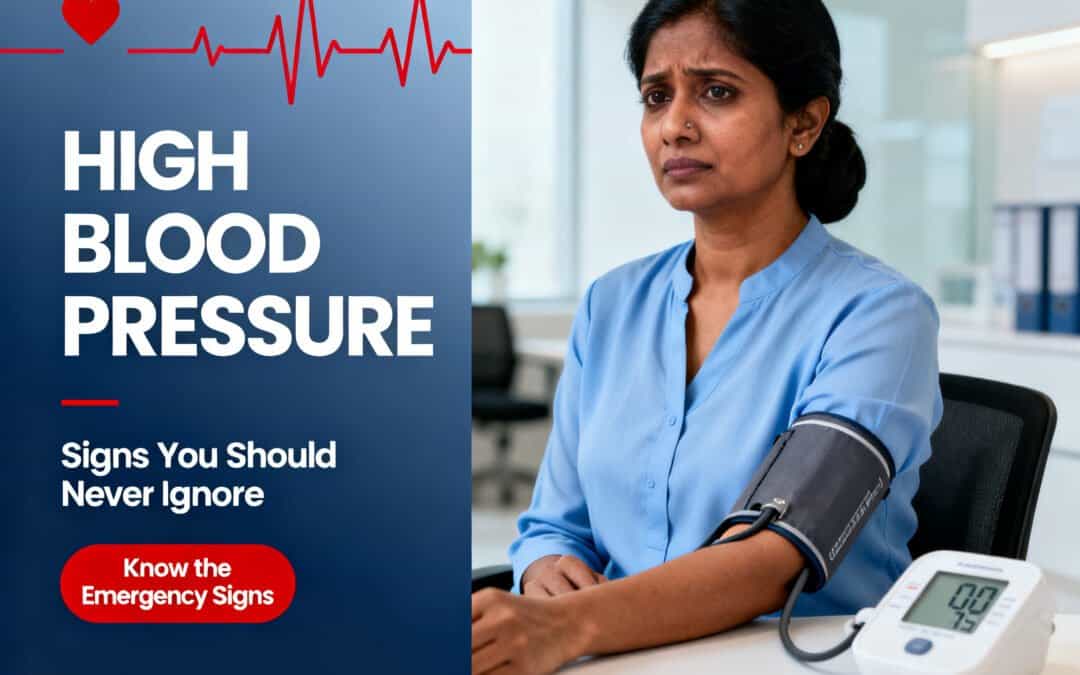
The most important fact about high blood pressure: The majority of people with hypertension — even those with readings of 160/100 or 180/110 — feel completely normal. No headache, no dizziness, no warning. This is why hypertension is called the silent killer. The damage to blood vessels, the heart, and the kidneys accumulates over years with no symptoms. Regular BP measurement is the only protection.
Hypertension is often discovered in people who came in for something completely unrelated — a fever, a diabetes check, a routine health screen — and are found to have BP of 170/110 or higher. They had no idea. This happens often.
This guide explains the symptoms that can occur with high blood pressure (and how common each one really is), how to distinguish a BP headache from a migraine, what a hypertensive crisis actually looks and feels like, the FAST stroke recognition test, what organs are silently damaged by untreated hypertension, and who should be checking their BP regularly regardless of symptoms.
Why High Blood Pressure Is Called the Silent Killer
The term “silent killer” is not metaphorical — it is a precise clinical description. Blood pressure can remain elevated for 5, 10, or 20 years while the person feels perfectly well. There are no pain receptors in blood vessel walls. There is no fever or rash to signal danger. The damage accumulates in the endothelium (inner lining of blood vessels), in the heart muscle, in the glomeruli of the kidneys, and in the retinal arteries — all without a single symptom.
By the time symptoms appear — a stroke, a heart attack, blurred vision, shortness of breath on climbing stairs — significant, often irreversible damage has already occurred. In India, an estimated 50–60% of hypertensive patients are unaware of their condition, and of those who know, many are not adequately treated or take medication only when they “feel something is wrong.”
The only way to detect hypertension before damage occurs is to measure blood pressure.
Symptoms That Can Occur With High Blood Pressure
The following symptoms can be associated with hypertension — but all have many other causes. For each, we describe how likely the symptom is to actually be due to BP:
1. Morning Headache (Back of the Head)
How common: Present in approximately 17% of people with hypertension; more common at BP above 160 systolic — not the majority.
Characteristics: Dull, throbbing, at the back of the skull (occipital), worst immediately on waking, gradually improving through the morning. May be accompanied by neck stiffness.
Mechanism: Raised intracranial pressure from sustained high BP; overnight BP “surging” before waking (morning surge) in the absence of evening medications.
Other causes of this pattern: Sleep apnoea (the most important alternate cause — morning headache + heavy snoring + daytime sleepiness = sleep apnoea study needed), tension headache, cervical spondylosis, prior evening alcohol.
Test it: Measure BP the moment you wake, before getting up. Do this for 7 consecutive mornings and record. Consistently above 145/90 — the headache is likely BP-related.
2. Dizziness and Lightheadedness
Important counter-intuitive fact: Dizziness is more often caused by low BP (or by BP medication that has lowered BP too aggressively) than by high BP. Uncomplicated hypertension does not increase dizziness frequency compared to normotensive controls.
When dizziness can signal high BP: A sudden, very acute rise in BP (hypertensive emergency) can cause sudden dizziness or vertigo. If dizziness occurs simultaneously with chest pain, vision changes, headache, or weakness — high BP is a possible cause and measurement is essential.
Postural dizziness on standing in a known hypertensive: Usually signals over-treatment. BP medication may be bringing BP too low on standing. Tell your doctor — they may adjust the dose or timing.
3. Nosebleeds (Epistaxis)
Nosebleeds occur in up to 5–10% of hypertensive patients during a BP spike — the elevated pressure can rupture fragile nasal capillaries. However, the vast majority of nosebleeds are caused by dry air, nose picking, nasal infections, or blood thinners — not high BP. A hypertension-related nosebleed is more likely when the bleed is profuse and difficult to stop, occurs alongside a very high BP reading (above 180/110), and there is no other obvious cause.
4. Visual Disturbances
Acute (during a BP crisis): Blurred vision, double vision, or scintillating (flashing) scotoma from elevated pressure transiently disrupting blood flow to the retina or visual cortex. Any acute vision change with a very high BP reading is an emergency.
Chronic (hypertensive retinopathy): Sustained hypertension causes progressive narrowing of retinal arterioles, flame-shaped haemorrhages, exudates (white cotton-wool spots), and in severe cases, papilloedema (optic disc swelling). Annual dilated fundus examination is recommended for all Stage 2 or above hypertensives.
5. Shortness of Breath
Shortness of breath from hypertension occurs when sustained elevated BP has caused left ventricular hypertrophy (thickened, stiffened heart muscle) or early heart failure — a sign of established organ damage, not early hypertension. Noticed first with exertion (climbing stairs, walking fast), then later at rest. Acute severe shortness of breath with very high BP can indicate hypertensive pulmonary oedema — a medical emergency.
6. Palpitations
Awareness of the heartbeat — thumping, racing, or irregular — can accompany high BP episodes. Sustained hypertension predisposes to atrial fibrillation (irregular heartbeat), which is itself a major cause of stroke. Irregular heartbeat + high BP reading = ECG needed the same day.
7. Blood in Urine (Haematuria)
Sustained uncontrolled hypertension damages glomerular capillaries, eventually causing protein and blood to leak into the urine. Visible blood in urine in a known hypertensive warrants same-day evaluation — it may indicate hypertensive nephropathy or a concurrent renal condition that itself is raising BP.
8. Facial Flushing
Red, flushed face is sometimes associated with sudden BP spikes but is far more commonly triggered by heat, alcohol, spicy food, emotional stress, or rosacea. It is not a reliable sign of hypertension and should not be used as a reason to take extra BP medication without measurement.
BP Headache vs Migraine vs Tension Headache
| Feature | Hypertensive Headache | Migraine | Tension Headache |
|---|---|---|---|
| Location | Occipital (back of skull) | Usually unilateral; may be bilateral | Band-like, forehead and temples |
| When worst | Morning, on waking | Any time; may wake from sleep | Evening; builds through the day |
| Quality | Dull, throbbing, heavy | Pulsating, throbbing, moderate-severe | Tight, pressing, band-like, mild-moderate |
| Aura | No | Yes in 30% — visual, sensory, speech changes | No |
| Nausea/vomiting | Mild if present | Yes — prominent feature | Usually not |
| Light/sound sensitivity | Mild or absent | Prominent — retreats to dark quiet room | Mild if present |
| Duration | Hours; improves through day | 4–72 hours; patient incapacitated | 30 min – 7 days; waxes and wanes |
| BP reading | Usually elevated when headache present | Usually normal or mildly elevated (pain response) | Usually normal |
Key rule: Measure BP whenever you have a significant headache. A normal reading rules out high BP as the cause. A reading of 160/100 or above during a headache makes BP the primary suspect.
Hypertensive Crisis — Complete Emergency Guide
A hypertensive crisis is defined as systolic BP of 180 mmHg or above, and/or diastolic of 120 mmHg or above. There are two distinct types:
Hypertensive Urgency
BP above 180/120 without signs of acute organ damage. The patient may have headache or mild symptoms, or feel nothing at all. Serious, requiring same-day medical evaluation and treatment — but does not require emergency ICU admission. Treatment is with oral antihypertensives; goal is to reduce BP gradually over 24–48 hours, not suddenly.
Hypertensive Emergency
BP above 180/120 with signs of acute organ damage — any of the following:
- Hypertensive encephalopathy (confusion, seizures, papilloedema)
- Haemorrhagic or ischaemic stroke
- Acute coronary syndrome (heart attack)
- Acute aortic dissection
- Hypertensive pulmonary oedema (lungs filling with fluid)
- Acute hypertensive nephropathy (rapidly rising creatinine)
- Preeclampsia/eclampsia in pregnancy
This is a true medical emergency requiring ICU admission, IV antihypertensive therapy, and continuous monitoring. The goal is to reduce mean arterial pressure by no more than 25% in the first hour — sudden large BP drops cause ischaemia to the brain, heart, and kidneys.
🚨 Go to Hospital Immediately — Hypertensive Emergency Signs
- Sudden severe headache — “the worst headache of my life”; thunderclap onset
- Chest pain or tightness — crushing, pressure-like, may radiate to arm or jaw
- Sudden tearing back pain — possible aortic dissection; “ripping” pain migrating from chest to back
- Acute shortness of breath at rest — especially with frothy pink sputum (pulmonary oedema)
- Sudden vision changes — blurring, double vision, or vision loss in one eye
- Confusion, extreme drowsiness, or inability to wake normally
- Difficulty speaking or understanding speech
- Sudden weakness or numbness on one side — face, arm, or leg
- Facial drooping on one side
- Seizure
- Profuse nosebleed that will not stop despite 20+ minutes of direct pressure
Do not drive yourself. Call someone, call 108 (Telangana emergency), or take an auto/taxi to the nearest emergency department. Time is brain — stroke treatment must begin within 4.5 hours of onset.
FAST Stroke Recognition — Know This, Save a Life
Stroke is the most devastating complication of hypertension and the single largest reason to control BP. Stroke treatment (IV thrombolysis) must begin within 4.5 hours of symptom onset — and ideally within 60–90 minutes. Recognising a stroke immediately is life-saving.
🧠 FAST — Recognise Stroke in 30 Seconds
F — Face: Ask the person to smile. Does one side droop? Is the smile asymmetric?
A — Arms: Ask them to raise both arms and hold for 10 seconds. Does one arm drift downward or fail to rise?
S — Speech: Ask them to repeat “The sky is blue.” Is speech slurred, garbled, confused, or absent?
T — Time: If any ONE of the above is present — call emergency services immediately. Note the exact time symptoms began.
Even if symptoms improve on their own within minutes (TIA — transient ischaemic attack), the patient must be seen in hospital immediately. A TIA carries 10–15% risk of a full stroke within 48 hours.
Additional stroke warning signs not captured in FAST: Sudden severe headache with no known cause; sudden vision loss in one eye; sudden loss of balance or coordination; sudden numbness or tingling on one side; sudden difficulty swallowing.
What NOT to Do in a Hypertensive Crisis
- Do NOT take an extra dose of your own BP medication without medical advice — uncontrolled rapid BP lowering causes ischaemia to the brain, heart, and kidneys
- Do NOT self-administer nifedipine (Adalat) sublingually — once recommended, now contraindicated; causes uncontrolled rapid BP drops and has caused strokes and heart attacks
- Do NOT wait to see if the reading “comes down on its own” if symptoms are present — every minute of untreated hypertensive emergency causes ongoing brain, heart, and kidney damage
- Do NOT lie the patient flat if they are having breathing difficulty — sit upright; lying flat worsens pulmonary oedema
- Do NOT give water to drink if the patient has difficulty swallowing or reduced consciousness — risk of aspiration
- Do NOT drive a patient to hospital yourself during a stroke — call 108; they can be treated en route if needed
What High BP Damages Silently — Over Years
The real danger of hypertension is not the occasional crisis — it is the relentless, silent, cumulative damage over years of even mildly elevated pressure. This is why treatment is not optional even when you feel completely fine.
| Organ | What High BP Does | Clinical Result | When Symptoms Appear |
|---|---|---|---|
| Heart | Heart works harder against high resistance; walls thicken (LVH); coronary arteries develop atherosclerosis | Heart failure; heart attack; atrial fibrillation; sudden cardiac death | After 10–20 years of uncontrolled hypertension; or suddenly with heart attack |
| Brain | Weakens cerebral artery walls; small vessel disease; can rupture arteries (haemorrhage) or cause clots (ischaemia) | Ischaemic stroke; haemorrhagic stroke; vascular dementia; TIA | Suddenly — stroke has no warning; vascular dementia develops over years |
| Kidneys | Glomerular capillary pressure rises; sclerosis and fibrosis; reduced filtration | Hypertensive nephropathy; proteinuria; CKD → dialysis | Detected by urine test years before symptoms; symptoms only when GFR below 30% |
| Eyes (Retina) | Retinal arteriole narrowing; haemorrhages; exudates; papilloedema | Hypertensive retinopathy; vision loss; in crisis — acute vision loss | Only detected by fundus examination; blurred vision only in advanced disease |
| Aorta / Large Arteries | Accelerates atherosclerosis and medial degeneration; aortic wall weakening | Aortic aneurysm; aortic dissection; peripheral artery disease | Aneurysm: silent until rupture; dissection: sudden catastrophic chest/back pain |
Who Must Check Their BP Regularly
- Everyone above age 30 — at minimum once a year, even with no symptoms
- Above age 40 — every 6 months
- Family history of hypertension, stroke, or heart attack — from age 20; screen every 6–12 months
- Known diabetics — every clinic visit; diabetes and hypertension dramatically amplify each other’s cardiovascular risk
- Overweight or central obesity (waist above 90 cm in men, 80 cm in women) — every 6 months
- Smokers — every 6 months; smoking causes an immediate 5–10 mmHg spike per cigarette and accelerates atherosclerosis
- Chronic stress, poor sleep, sedentary lifestyle — regular monitoring; these are independent BP risk factors
- Pregnant women — every antenatal visit; preeclampsia develops rapidly and is life-threatening to both mother and baby
- Anyone with CKD or prior heart attack/stroke — every clinic visit; BP targets are stricter and deviation more dangerous in these patients
Frequently Asked Questions
What are the signs of high blood pressure?
Most people have none — this is why it is called the silent killer. When symptoms do occur: morning headache at the back of the head, dizziness, nosebleeds, visual disturbances, palpitations, or shortness of breath. None is specific to hypertension. Measuring BP is the only reliable detection method.
Can high BP cause headaches?
Yes — but typically only above 160 systolic. The classic hypertensive headache is dull, occipital (back of skull), worst on waking, improving through the day. A sudden “worst headache of life” with very high BP is an emergency.
What does a hypertensive crisis feel like?
Severe sudden headache, chest pain, vision changes, confusion, difficulty speaking, one-sided facial drooping or arm weakness, or breathlessness — with BP of 180/120 or above. Some feel nothing at all. Either way: emergency care immediately.
What is the FAST test for stroke?
F = Face drooping (asymmetric smile); A = Arm weakness (one arm drifts down when both raised); S = Speech difficulty (slurred, garbled, or absent); T = Time — call emergency services immediately if any one sign is present. Note the exact time symptoms began.
Is a morning headache a sign of high BP?
Possibly. Measure BP the moment you wake for 7 days. Consistently above 145/90 — likely yes. Also consider sleep apnoea (causes identical morning headaches + snoring). Tell your doctor if this pattern recurs.
Can high BP cause dizziness?
Rarely — dizziness is more often caused by low BP, dehydration, inner ear problems, or over-treatment of hypertension (postural hypotension). If dizziness occurs alongside chest pain, vision changes, or limb weakness — treat as emergency.
How is a hypertensive headache different from a migraine?
Hypertensive: dull, occipital, worst on waking, bilateral, no aura, eases through day. Migraine: throbbing, often unilateral, with aura in 30%, prominent nausea/vomiting, light/sound sensitivity, lasts 4–72 hours, often incapacitating. Measure BP when the headache is present — this is the key distinguishing step.
What damage does untreated high BP cause?
Heart (failure, heart attack), brain (stroke, vascular dementia), kidneys (kidney failure requiring dialysis), eyes (retinopathy, vision loss), and arteries (aneurysm, dissection). All silently, over years. By the time symptoms appear, significant damage has already occurred.
What NOT to do in a hypertensive crisis?
Do not self-administer extra BP tablets or sublingual nifedipine (Adalat). Do not wait to see if readings “come down.” Do not drive the patient yourself during stroke symptoms. Do not lie a breathless patient flat. Call 108 or go to emergency immediately.
Can high BP cause blurred vision?
Yes — acutely from a BP surge affecting retinal blood flow, and chronically from hypertensive retinopathy. Any sudden vision change with high BP is an emergency. All Stage 2 hypertensives should have annual fundus examinations.
What is hypertensive encephalopathy?
A severe complication of extreme hypertension (typically above 200/120) where the blood-brain barrier breaks down causing brain swelling. Symptoms: severe headache, confusion, drowsiness, seizures. Distinguished from stroke by global (brain-wide) rather than focal (one-sided) symptoms. Requires immediate IV antihypertensive treatment in ICU.
Related Health Guides
This article is for general health information only and is not a substitute for personal medical advice. In an emergency, call 112 or go to the nearest hospital.

Trackbacks/Pingbacks