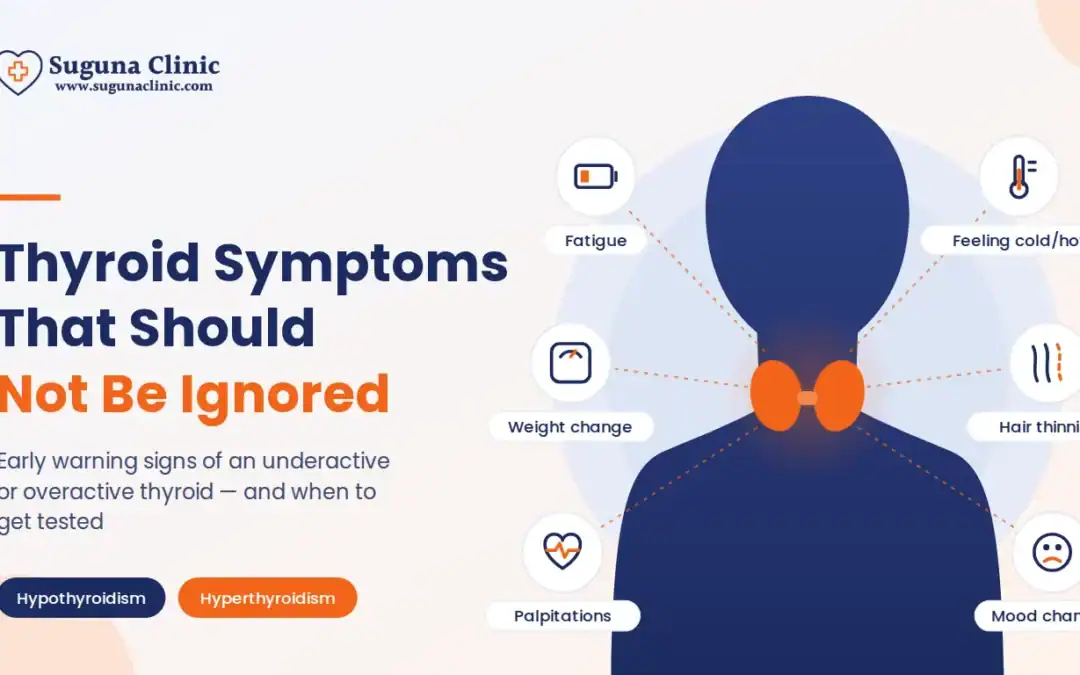
Thyroid symptoms are easy to dismiss because they creep in slowly and look like everyday problems — tiredness, weight change, hair fall, feeling low or feeling on edge. Yet a thyroid gland that is working too slowly (hypothyroidism) or too fast (hyperthyroidism) affects almost every organ in the body, and a simple blood test can usually find the cause.
Quick answer
The thyroid symptoms that should not be ignored are: persistent fatigue, unexplained weight gain or loss, feeling unusually cold or hot, a slow or racing heartbeat, hair thinning and dry skin, mood changes, menstrual changes, bowel changes, tremor or muscle weakness, eye changes, hoarseness, and any swelling or lump in the front of the neck. If two or more of these last longer than a few weeks, ask a doctor about a TSH blood test. Difficulty breathing or swallowing, a fast-growing neck lump, or a very fast heartbeat with fever or confusion needs same-day medical care.
Last updated: September 2026 · Reading time: about 10 minutes
What the Thyroid Gland Does
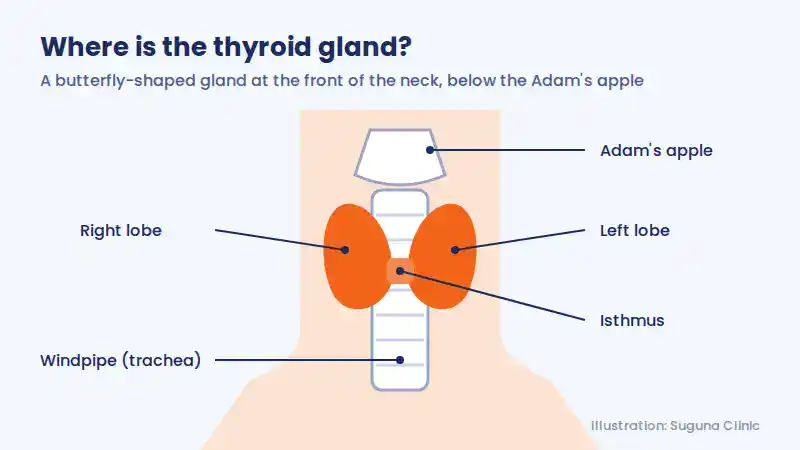
The thyroid is a small, butterfly-shaped gland at the front of the neck, just below the Adam’s apple. It makes two hormones — thyroxine (T4) and triiodothyronine (T3) — that set the speed of your metabolism. They influence your heart rate, body temperature, energy levels, weight, digestion, menstrual cycle, mood and even how quickly your hair and skin renew.
The gland is controlled by the pituitary gland in the brain, which releases thyroid-stimulating hormone (TSH). When thyroid hormone is low, TSH rises; when thyroid hormone is high, TSH falls. That is why TSH is usually the first test doctors order.
Why Thyroid Symptoms Are Often Missed
Thyroid disease is common in India. A multi-city study of 5,360 adults — including participants from Hyderabad — published in the Indian Journal of Endocrinology and Metabolism (2013) found hypothyroidism in about 1 in 10 adults (10.95%). Nearly one-third of those cases (3.47% of all participants) had not been diagnosed before. Women were affected about three times as often as men (15.86% vs 5.02%).
Symptoms are missed because they:
- Develop gradually over months, so people adapt to them.
- Overlap with common problems such as stress, anaemia, vitamin D or B12 deficiency, poor sleep, menopause or depression.
- Vary from person to person — older adults, in particular, may have few or unusual symptoms.
- Are blamed on age or lifestyle (“I’m just tired”, “it’s the weather”, “it’s work pressure”).
12 Thyroid Symptoms You Should Not Ignore
No single symptom proves a thyroid problem. What matters is a pattern of several symptoms that persist for weeks. Here are the most important ones, with whether they usually point to an underactive (hypo) or overactive (hyper) thyroid.
1. Persistent fatigue
Tiredness that sleep does not fix is one of the earliest signs of hypothyroidism. An overactive thyroid can also cause exhaustion because the body is running too fast.
2. Unexplained weight change
Modest weight gain without eating more suggests hypothyroidism. Weight loss despite a good or increased appetite suggests hyperthyroidism.
3. Feeling too cold or too hot
Feeling cold when others are comfortable points to an underactive thyroid. Heat intolerance and excessive sweating point to an overactive one.
4. Slow or racing heartbeat
Palpitations, a pounding or irregular heartbeat, or a resting pulse that stays high are classic hyperthyroid signs. A slow pulse can occur with hypothyroidism.
5. Hair thinning, dry skin, brittle nails
Diffuse hair fall, coarse dry hair, rough skin and brittle nails are common with hypothyroidism. Fine, thinning hair can also occur with hyperthyroidism.
6. Mood and memory changes
Low mood, slowed thinking and poor concentration fit hypothyroidism. Anxiety, irritability, restlessness and poor sleep fit hyperthyroidism.
7. Swelling or lump in the neck
A visible swelling (goitre) or a lump (nodule) at the front of the neck should always be checked, even if you feel well and thyroid tests are normal.
8. Hoarse voice or trouble swallowing
A voice change lasting more than a few weeks, a feeling of pressure in the throat, or food sticking can be caused by an enlarged thyroid or nodule.
9. Menstrual and fertility changes
Heavy or irregular periods are linked to hypothyroidism; light or infrequent periods to hyperthyroidism. Both can make it harder to conceive.
10. Bowel changes
New, persistent constipation suggests a slow thyroid. Frequent or loose stools suggest an overactive thyroid.
11. Tremor, cramps or muscle weakness
A fine shake of the hands and weak thigh muscles (difficulty climbing stairs) fit hyperthyroidism. Muscle aches, stiffness and cramps fit hypothyroidism.
12. Eye changes
Bulging, red, gritty or watery eyes, puffy eyelids or double vision can be caused by Graves’ disease and need prompt assessment.
Hypothyroidism vs Hyperthyroidism Symptoms: Side-by-Side
Many thyroid symptoms are “mirror images” of each other. This table helps you see which pattern fits you better — but only blood tests can confirm it.
| Body area | Underactive thyroid (hypothyroidism) | Overactive thyroid (hyperthyroidism) |
|---|---|---|
| Energy | Tired, sluggish, sleepy | Restless, “wired but tired”, poor sleep |
| Weight | Modest weight gain | Weight loss with increased appetite |
| Temperature | Feels cold | Feels hot, sweats easily |
| Heart | Slow pulse | Fast or irregular pulse, palpitations |
| Skin and hair | Dry skin, coarse hair, puffy face | Warm, moist skin; fine, thinning hair |
| Mood | Low mood, slowed thinking | Anxiety, irritability |
| Digestion | Constipation | Frequent, loose stools |
| Periods | Heavy or irregular | Light or infrequent |
| Muscles | Aches, stiffness, cramps | Tremor, weak thigh and arm muscles |
| Voice / neck | Hoarse voice; goitre possible | Goitre possible; eye changes in Graves’ disease |
| TSH result | Usually high | Usually low |
Red-Flag Thyroid Symptoms That Need Urgent Care
⚠️ Seek medical care the same day (or go to an emergency department) if you have:
- Difficulty breathing or swallowing, or noisy breathing, with a neck swelling.
- A neck lump that is growing quickly, feels hard or fixed, or comes with a persistent hoarse voice.
- A very fast or irregular heartbeat, chest pain, fainting or breathlessness.
- High fever with a racing heart, agitation, confusion, vomiting or diarrhoea in someone with an overactive thyroid — this can be a thyroid storm, a rare but life-threatening emergency.
- Extreme drowsiness, confusion, very low body temperature or slow breathing in someone with severe untreated hypothyroidism — a rare emergency called myxoedema coma.
- Sudden eye pain, loss of vision or double vision.
Who Is at Higher Risk of Thyroid Problems?
Anyone can develop a thyroid disorder, but your chances are higher if you:
- Are a woman, especially during pregnancy, in the year after childbirth, or around menopause.
- Have a family history of thyroid disease.
- Have another autoimmune condition such as type 1 diabetes, vitiligo, rheumatoid arthritis, coeliac disease or pernicious anaemia.
- Are over 60.
- Have had thyroid surgery, radioactive iodine, or radiation to the head or neck.
- Take medicines that affect the thyroid, such as amiodarone, lithium or certain cancer immunotherapies.
- Have Down syndrome or Turner syndrome.
What to Do If You Notice Thyroid Symptoms: A Simple Flowchart
Use this step-by-step path to decide your next move. It is a guide, not a diagnosis.
Trouble breathing or swallowing, fast-growing lump, very fast heartbeat, fever with confusion
Emergency department or urgent doctor visit
Note them down with dates
Free T4 is often added
Possible underactive thyroid → free T4, anti-TPO
Possible overactive thyroid → free T4, T3, TRAb
Look for other causes; ultrasound if there is a neck lump
Thyroid Tests Explained
Most thyroid problems are diagnosed with a blood test. Fasting is usually not required, but tell the lab if you take biotin (vitamin B7) supplements, because high doses can distort some thyroid results.
| Test | What it shows | When it is used |
|---|---|---|
| TSH | The brain’s signal to the thyroid. High TSH usually means an underactive thyroid; low TSH usually means an overactive one. | First test for almost everyone with symptoms |
| Free T4 | The main hormone the thyroid releases | Confirms and grades an abnormal TSH |
| T3 / Free T3 | The active form of thyroid hormone | Mainly when an overactive thyroid is suspected |
| Anti-TPO antibodies | Autoimmune attack on the thyroid (Hashimoto’s thyroiditis) | When TSH is high or borderline |
| TRAb (TSH receptor antibodies) | Antibodies that switch the thyroid on (Graves’ disease) | When TSH is low |
| Thyroid ultrasound | Size and structure of the gland, nodules | Any neck swelling or lump |
| FNAC (fine-needle aspiration) | Cells taken from a nodule with a thin needle | Nodules with suspicious ultrasound features |
Understanding your TSH number: many laboratories use an adult reference range of roughly 0.4–4.5 mIU/L, but ranges vary between labs and are different in pregnancy. A single slightly abnormal value is often repeated after 6–8 weeks before any decision is made. Always interpret your report with your doctor. For help reading other common reports, see our guide to understanding CBC, LFT and KFT blood tests.
Common Thyroid Conditions Behind the Symptoms
| Condition | What happens | Typical effect |
|---|---|---|
| Hashimoto’s thyroiditis | The immune system gradually damages the thyroid | Most common cause of hypothyroidism |
| Graves’ disease | Antibodies over-stimulate the thyroid | Most common cause of hyperthyroidism; may affect the eyes |
| Toxic nodule / multinodular goitre | One or more lumps make excess hormone | Hyperthyroidism, often in older adults |
| Thyroiditis (including postpartum) | Inflammation leaks stored hormone, then the gland may slow down | Temporary overactive phase, sometimes followed by an underactive phase |
| Thyroid nodules | Lumps within the gland; most are benign | Often no hormone change; need ultrasound assessment |
| Thyroid cancer | Uncommon; usually presents as a painless lump | Hormone levels usually normal; most types are highly treatable |
How Thyroid Problems Are Treated
Treatment depends on the cause, your age, pregnancy plans and other health conditions. Your doctor will decide the medicine, dose and follow-up schedule.
Underactive thyroid
- Daily levothyroxine tablet replaces the missing hormone.
- Usually taken on an empty stomach, at the same time each day, apart from calcium and iron supplements.
- TSH is rechecked about 6–8 weeks after starting or changing the dose.
- Most people need it long-term — do not stop it on your own.
Overactive thyroid
- Antithyroid medicines reduce hormone production.
- Beta-blockers may ease palpitations and tremor while other treatment starts to work.
- Radioactive iodine or surgery may be advised for some people.
- Regular blood tests monitor response and side effects.
Thyroid lumps are assessed with ultrasound and, when needed, FNAC. Many benign nodules only need periodic monitoring.
Thyroid Symptoms in Women, Pregnancy and After Childbirth
Women are more likely than men to develop thyroid disease, and some symptoms are easily confused with hormonal changes of life stages.
- Trying to conceive: irregular cycles or difficulty getting pregnant are good reasons to check thyroid function.
- Pregnancy: the baby depends on the mother’s thyroid hormone in early pregnancy. Women already on levothyroxine often need a dose adjustment as soon as pregnancy is confirmed — contact your doctor promptly.
- After childbirth: postpartum thyroiditis can cause anxiety, palpitations and weight loss, followed months later by tiredness and low mood. It is often mistaken for “new-mother exhaustion” or postpartum depression.
- Perimenopause and menopause: hot flushes, mood swings, sleep problems and weight change overlap with thyroid symptoms, so testing helps separate the two.
Thyroid Myths vs Facts
| Myth | Fact |
|---|---|
| “Thyroid problems only cause weight gain.” | An overactive thyroid usually causes weight loss, and many people with hypothyroidism gain only a few kilos. |
| “If I feel fine, I can stop my thyroid tablet.” | Feeling well usually means the dose is working. Stopping can bring symptoms back. Change doses only with your doctor. |
| “Iodised salt prevents all thyroid disease.” | Iodine prevents deficiency goitre, but the most common causes today are autoimmune and are not prevented by salt. |
| “A normal TSH means a neck lump is harmless.” | Nodules often occur with normal hormone levels. Every new lump needs an examination and usually an ultrasound. |
| “Thyroid disease only affects women.” | Women are affected more often, but men, children and older adults can all develop thyroid disorders. |
When to See a Doctor for Thyroid Symptoms in Hyderabad
Book a check-up if you have two or more of the symptoms above for more than two to three weeks, a family history of thyroid disease with new symptoms, any neck swelling, or you are planning a pregnancy. Bring a list of your symptoms, when they started, your medicines and supplements, and any previous thyroid reports.
At Suguna Clinic in Hyderabad, thyroid symptoms are assessed with a clinical examination and the appropriate blood tests, and ongoing care includes dose adjustment and follow-up. Learn more about our thyroid treatment services. If you are due for routine screening, our guide to health check-up tests after 30, 40 and 50 explains where thyroid testing fits in.
Frequently Asked Questions
What are the first signs of a thyroid problem?
Early signs are often vague: tiredness that does not improve with rest, unexplained weight change, feeling unusually cold or hot, hair thinning, and changes in mood or periods. A swelling at the front of the neck is a more specific early sign.
Which blood test checks for thyroid problems?
The TSH (thyroid-stimulating hormone) test is the main screening test. If TSH is abnormal, doctors usually add free T4, and sometimes T3 and thyroid antibody tests.
Can thyroid problems cause hair loss?
Yes. Both underactive and overactive thyroid can cause diffuse hair thinning. Hair usually recovers over several months once thyroid levels are corrected, although other causes such as iron deficiency should also be checked.
Can thyroid disease cause anxiety or depression?
An overactive thyroid can cause anxiety, irritability and poor sleep, while an underactive thyroid can cause low mood and slowed thinking. Doctors often check thyroid function when someone has new mood symptoms.
Is a thyroid lump always cancer?
No. Most thyroid nodules are benign. However, every new lump should be examined, and an ultrasound helps decide whether a needle test (FNAC) is needed.
Can thyroid problems be cured?
Some types, such as postpartum thyroiditis, often settle on their own. Hashimoto’s hypothyroidism is usually lifelong but well controlled with a daily tablet. Hyperthyroidism can often be brought into long-term remission or permanently treated with medicines, radioactive iodine or surgery.
How often should thyroid levels be checked?
After starting or changing thyroid medicine, TSH is usually checked in about 6–8 weeks. Once stable, many people are tested once or twice a year, or as their doctor advises.
Sources and Further Reading
- Unnikrishnan AG et al. Prevalence of hypothyroidism in adults: an epidemiological study in eight cities of India. Indian J Endocrinol Metab. 2013;17(4):647–652.
- NIDDK (US National Institutes of Health): Hypothyroidism (Underactive Thyroid)
- NIDDK (US National Institutes of Health): Hyperthyroidism (Overactive Thyroid)
- American Thyroid Association: Thyroid information for patients
This article provides general health information and does not replace an individual medical assessment. If you have symptoms or concerns, please consult a qualified doctor.