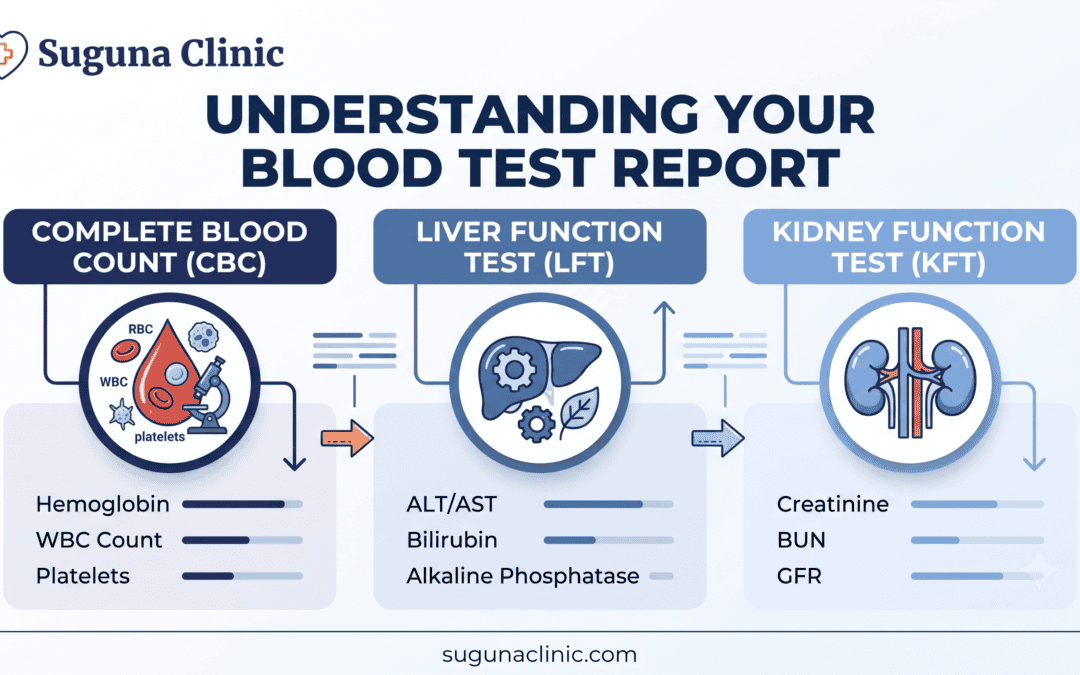
Quick answer: CBC, LFT, and KFT are the three blood panels most commonly ordered in routine checkups in India — checking your blood cells, liver, and kidneys respectively. Most values on these reports have a printed “normal range” next to them, and a single value slightly outside that range is usually not an emergency; what matters more is the overall pattern and how it compares to your previous reports. This guide explains what each commonly confusing abbreviation actually measures, what counts as normal, and which specific results genuinely warrant a prompt call to your doctor rather than a wait-and-see approach.
At Dr. Ram Kumar’s Suguna Clinic in Hydershakote, one of the most common moments in a consultation is a patient placing a printed report on the desk and asking, “Doctor, is this okay?” — often having spent the previous night searching individual abbreviations online and arriving more worried than the result actually warranted. This guide walks through exactly what CBC, LFT, and KFT check, in plain language, so your next report is something you can actually read — not just hand over.
Blood Test Basics — At a Glance
- CBC (Complete Blood Count) checks your blood cells — screens for anaemia, infection, and clotting-related issues.
- LFT (Liver Function Test) checks liver enzymes and proteins — flags liver inflammation, damage, or impaired function.
- KFT (Kidney Function Test, also called RFT) checks how well your kidneys filter waste from your blood.
- Reference ranges vary slightly by lab — always check the range printed on your specific report, not just a number you’ve seen elsewhere.
- One mildly abnormal value is common and often not significant on its own — the overall pattern, and the trend compared to previous reports, usually matters more.
CBC: Complete Blood Count
A CBC is the single most commonly ordered blood test, and gives a snapshot of your red cells, white cells, and platelets:
| Value | Typical Normal Range | What It Tells You |
|---|---|---|
| Haemoglobin (Hb) | Women: 12–16 g/dL Men: 13–17 g/dL |
Low levels suggest anaemia; very high levels can indicate dehydration or other conditions |
| MCV (mean corpuscular volume) | Roughly 80–100 fL | A genuinely useful clue: low MCV with anaemia usually points to iron deficiency; high MCV with anaemia points toward B12 or folate deficiency — see our guides on iron deficiency and B12 deficiency |
| White blood cells (WBC) | Roughly 4,000–11,000 /µL | High counts often suggest infection or inflammation; low counts can indicate a viral infection or, less commonly, a bone marrow issue |
| Platelets | Roughly 150,000–450,000 /µL | Low counts affect clotting and are checked closely during illnesses like dengue; high counts can occur with inflammation or after blood loss |
| Haematocrit (Hct) | Women: 37–47% Men: 42–52% |
The percentage of blood made up of red cells; tracks closely with haemoglobin and anaemia status |
LFT: Liver Function Test
An LFT panel checks liver enzymes (released when liver cells are stressed or damaged) alongside proteins the liver produces:
| Value | Typical Normal Range | What It Tells You |
|---|---|---|
| ALT / SGPT | Roughly 7–56 U/L | The most liver-specific enzyme; mild elevation is common with fatty liver disease, though it’s often normal even when fatty liver is present |
| AST / SGOT | Roughly 10–40 U/L | Also found in muscle and heart tissue, so it’s less liver-specific than ALT alone — doctors usually interpret the two together |
| ALP (alkaline phosphatase) | Roughly 44–147 U/L | Can rise with bile duct issues, certain liver conditions, or normally in growing children and bone-related conditions |
| Bilirubin (total) | Roughly 0.1–1.2 mg/dL | The pigment responsible for jaundice when elevated; can rise from liver issues or increased red cell breakdown |
| Albumin | Roughly 3.5–5.0 g/dL | Reflects the liver’s protein-making ability; low levels can suggest chronic liver disease or poor nutrition |
KFT: Kidney Function Test
A KFT (sometimes called an RFT — Renal Function Test) checks how well your kidneys are filtering waste products from your blood:
| Value | Typical Normal Range | What It Tells You |
|---|---|---|
| Creatinine | Men: 0.7–1.3 mg/dL Women: 0.6–1.1 mg/dL |
A waste product filtered by the kidneys; rising creatinine over time is one of the clearest markers of declining kidney function |
| eGFR | 90 mL/min/1.73m² or above | Calculated from creatinine; a more direct estimate of how well your kidneys are filtering than creatinine alone — values below 60 for 3+ months suggest chronic kidney disease |
| Blood urea / BUN | Roughly 7–20 mg/dL | Another waste product; elevated levels alongside high creatinine reinforce a kidney-related cause |
| Uric acid | Men: 3.5–7.2 mg/dL Women: 2.6–6.0 mg/dL |
High levels are linked to gout and certain kidney stone types |
Reading the Pattern, Not Just One Red Number
It’s tempting to zero in on the single value your lab report has marked in red or bold, but that’s often not where the real story is. A value just outside the printed range — especially by a small margin — is common and frequently not clinically significant on its own, particularly if it’s an isolated finding with no accompanying symptoms. What genuinely matters more:
- The overall pattern — several related values moving in the same direction together (like ALT, AST, and a fatty liver ultrasound finding) is more meaningful than one number in isolation
- The trend over time — a creatinine that’s risen steadily over three consecutive annual reports, even while staying within the “normal” range, is worth flagging — this is exactly why bringing your previous year’s report to a checkup matters
- Whether it fits your symptoms and risk factors — the same mildly elevated ALT means something different in someone with diabetes and obesity versus someone with no other risk factors
Results That Warrant a Prompt Call to Your Doctor
- ALT/SGPT or AST/SGOT more than 3 times the upper limit of normal
- Bilirubin above 2 mg/dL, especially with yellowing of the skin or eyes
- eGFR below 60, particularly if it’s a new finding or has dropped from a previous report
- Haemoglobin significantly below the normal range, especially with symptoms like breathlessness or chest discomfort
- A very low platelet count, especially during a fever illness (relevant for dengue monitoring)
These aren’t reasons to panic on their own, but they are reasons to call your doctor promptly rather than waiting for your next scheduled visit.
What to Do When Something Is Flagged
- Don’t self-diagnose from a single abnormal value — the same number can mean different things depending on your full clinical picture
- Bring your previous reports to your next appointment so trends can be compared, not just the single most recent number
- Ask specifically what it means for you — a good doctor will explain the likely cause and next step, not just confirm the number is “a bit high”
- Follow up on the recommended timeline — many mildly abnormal results are simply rechecked in 4–12 weeks after a lifestyle change, rather than requiring immediate treatment
When to See a Doctor
- Any of the specific red-flag results listed above
- A report you don’t understand, even if nothing appears to be marked abnormal — asking is always reasonable
- Results that don’t match how you feel — for instance, a “normal” report despite persistent symptoms deserves a further conversation, not automatic reassurance
- It’s been over a year since you last had these panels checked — see our guide to full body checkups by age for how often these are recommended
Frequently Asked Questions
What do CBC, LFT, and KFT stand for?
CBC is Complete Blood Count (checks blood cells), LFT is Liver Function Test (checks liver enzymes and proteins), and KFT is Kidney Function Test, sometimes called RFT (checks how well your kidneys filter waste).
Is one abnormal value on my report something to worry about?
Not necessarily. A single value slightly outside the printed range is common and often not significant on its own — the overall pattern across related values, and the trend compared to your previous reports, usually matter more than one isolated number.
What does a high MCV or low MCV mean?
MCV measures the size of your red blood cells. Combined with anaemia, a low MCV typically points toward iron deficiency, while a high MCV points toward vitamin B12 or folate deficiency — a genuinely useful clue for narrowing down the cause.
Do I need to fast before these tests?
CBC generally doesn’t require fasting. LFT is often best done after 8–12 hours of fasting for accuracy. KFT requirements vary — ask when booking, or fast overnight to be safe.
What liver enzyme level should worry me?
ALT (SGPT) or AST (SGOT) more than 3 times the upper limit of normal, or bilirubin above 2 mg/dL — especially with yellowing of the skin or eyes — warrant a prompt call to your doctor rather than waiting.
What does a low eGFR mean?
eGFR estimates how well your kidneys are filtering blood. A reading below 60, especially if new or declining from a previous report, suggests reduced kidney function and is worth discussing with your doctor promptly.
Why does my doctor look at old reports alongside the new one?
Because trends over time are often more informative than a single reading. A value that’s climbed steadily across several reports, even while staying “in range,” can be an earlier warning sign than waiting for it to cross the line.
Can I interpret my blood report without a doctor?
You can understand what each value generally measures, but interpreting what it means for you specifically requires clinical context — your symptoms, other results, and history. Use this guide to have a more informed conversation, not to replace one.
Get Your Reports Reviewed at Suguna Clinic
📍 Suguna Clinic — Vinayak Nagar, Hydershakote, Bandlaguda Jagir, Telangana 500091
📞 Call / WhatsApp: 09618994555 | Book online
Bring any report you don’t fully understand to Dr. Ram Kumar — a proper review looks at the full pattern and your history, not just the numbers marked in red.
Trackbacks/Pingbacks