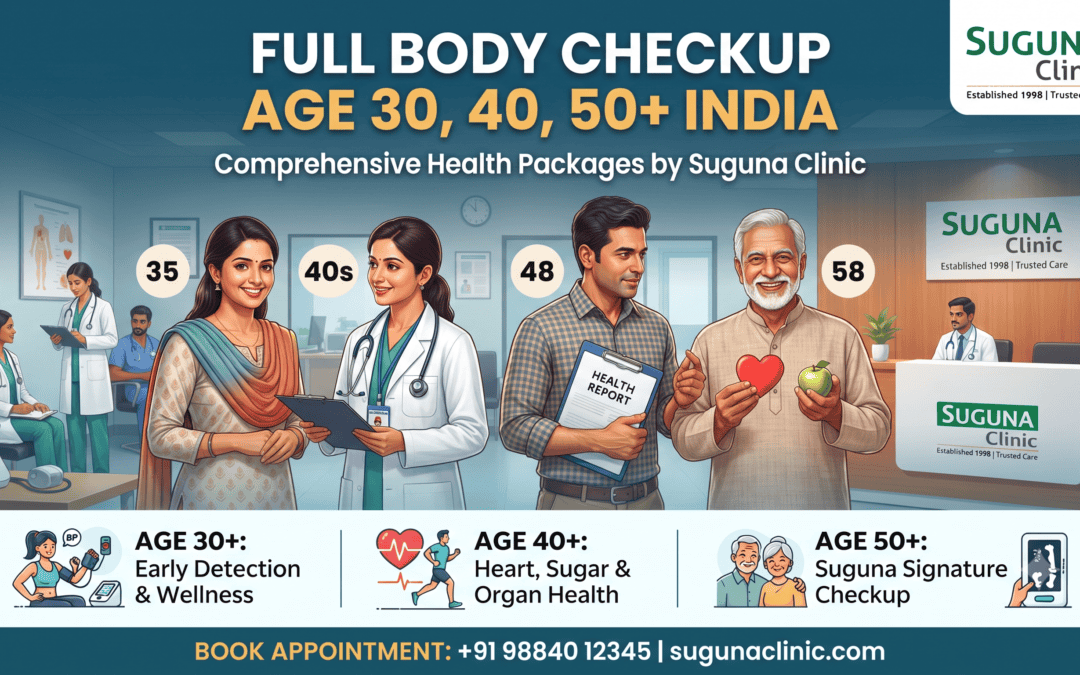
Quick answer: Only about 1 in 3 Indians get regular preventive health screening — yet a 2023 Indian Journal of Public Health study found that people who had annual checkups were 40% less likely to be hospitalized for preventable conditions like heart attacks or kidney failure. The tests that actually matter change by decade: your 30s are about building a baseline, your 40s are when silent conditions like diabetes, fatty liver, and cardiovascular risk most often go undetected, and your 50s add cancer and bone health screening. You don’t need a 70-test package — you need the right dozen, done consistently.
At Dr. Ram Kumar’s Suguna Clinic in Hydershakote, the most common regret isn’t a missed diagnosis — it’s patients realising a condition like diabetes or fatty liver had likely been building quietly for years before it was ever tested for. Most chronic diseases that show up in your 40s and 50s give no symptoms in their early stages. This guide breaks down exactly which tests matter at each life stage, how often to repeat them, and how to avoid paying for a checkup package stuffed with tests you don’t actually need.
Health Checkups by Age — At a Glance
- Under 35 with no risk factors: every 2 years is reasonable. 35 and above: annual checkups are worth it. After 50: key values like BP, sugar, and kidney function are best reviewed every 6–12 months.
- Your 30s are about establishing a baseline — blood sugar, cholesterol, thyroid, vitamin D and B12, kidney and liver function.
- Your 40s are the highest-yield decade for catching silent disease — this is when diabetes, fatty liver, and cardiovascular risk most commonly first show up on tests, often with no symptoms at all.
- Your 50s add structured cancer screening, bone density, and more frequent monitoring of everything established in your 30s and 40s.
- A well-designed panel costs roughly ₹3,500–6,000 at a private diagnostic centre — more tests isn’t automatically better.
Why Regular Checkups Matter More Than You Think
Most people see a doctor only once something already feels wrong. But by the time symptoms appear, conditions like diabetes, high cholesterol, fatty liver, and early kidney disease have often been silently progressing for years — this is precisely why they’re called “silent” conditions. A 2023 study in the Indian Journal of Public Health found that people with annual health screenings were 40% less likely to be hospitalised for preventable conditions such as heart attacks or kidney failure. Yet only around a third of Indian adults get screened regularly, often due to the assumption that checkups are only needed when something feels off, or that they’re an unnecessary expense.
How Often Should You Get Checked?
| Age / Risk Group | Recommended Frequency |
|---|---|
| Under 35, no chronic conditions or family history | Every 2 years |
| 35 and above | Annually |
| Any age, with diabetes, hypertension, or strong family history | Annually, regardless of age — and more frequently for the specific condition being monitored |
| 50 and above | Key values (blood pressure, blood sugar, kidney function) every 6–12 months |
Your 30s: Building a Baseline
Many chronic diseases that show up in your 40s and 50s are already taking root in your 30s. This is the decade to establish what “normal” looks like for your own body, so any future change is easy to spot:
| Test | Why |
|---|---|
| CBC (complete blood count) | Screens for anaemia, especially important for menstruating women |
| Fasting glucose and HbA1c | Catches prediabetes years before symptoms — Indians develop diabetes at a younger age and lower BMI than Western populations |
| Lipid profile | Establishes a cholesterol baseline before risk starts climbing in the 40s |
| Thyroid (TSH) | Thyroid disorders are common and easily missed, especially in women |
| Vitamin D and B12 | Deficiency in both is extremely common in India — see our guides on vitamin D and B12 deficiency |
| Kidney and liver function | A baseline that makes any future change easy to catch early |
| Blood pressure | Should be checked at every visit regardless of age — hypertension is symptomless until it isn’t |
| Pap smear (women, from 30) + clinical breast exam | Cervical cancer screening every 3 years from 30; breast, cervix, and oral cavity cancers together account for roughly a third of all cancers in India |
Your 40s: When Risk Becomes Real
This is the highest-yield decade for catching silent disease. Cardiovascular disease, type 2 diabetes, fatty liver, and early kidney disease are most likely to first appear — or be missed — during this period:
| Test | Why |
|---|---|
| Everything from your 30s panel | Continue annually — trends over time matter more than any single reading |
| Resting ECG | Paired with your lipid profile, establishes a cardiovascular baseline before risk escalates |
| Liver function test (LFT) and abdominal ultrasound | Fatty liver disease affects an estimated 38% of urban Indians, often peaking in this exact age range — see our full guide to fatty liver disease |
| Kidney function: creatinine, eGFR, urine microalbumin | Detects early kidney disease before irreversible damage, especially important with diabetes or high blood pressure |
| Mammogram (women, from 40) | Annual screening from 40 is the standard recommendation for breast cancer detection |
| Colonoscopy (from 40–45) | Every 5–10 years, to detect precancerous polyps before they progress |
| Bone density (DEXA), women especially | Every 2 years from 40, since perimenopausal bone loss accelerates significantly in Indian women already prone to low vitamin D and calcium intake |
Your 50s and Beyond: Comprehensive Monitoring
| Test | Why |
|---|---|
| Everything from your 30s and 40s panel | Continue, with blood pressure, blood sugar, and kidney function reviewed every 6–12 months |
| PSA test (men) | Prostate cancer screening, typically discussed with your doctor from age 50 (earlier with family history) |
| Continued colonoscopy | Repeated on the interval your doctor recommends based on prior findings |
| Cognitive and mood screening | A simple conversation-based check becomes more relevant from this decade onward |
| Eye and hearing checks | Age-related changes are common and often under-reported by patients themselves |
A Note for Women Specifically
Beyond the age-based schedule above, a few things are worth flagging on their own: irregular periods, unexplained weight changes, or acne/excess hair growth at any age are worth discussing with your doctor rather than waiting for a scheduled checkup — see our guide to PCOS/PCOD symptoms and diagnosis if this sounds familiar. And given how common iron deficiency is in Indian women specifically, a haemoglobin and ferritin check is worth asking for even outside a full package — our iron deficiency anaemia guide covers what the numbers mean.
What a Good Checkup Package Actually Includes
More tests isn’t automatically better. A well-designed panel for your age and risk profile costs roughly ₹3,500–6,000 at a private diagnostic centre in most Indian cities — you don’t need to pay for a 50-test package to get meaningful coverage.
What to avoid: Packages padded with dozens of tests you don’t need based on your age or risk factors, marketed mainly to justify a higher price. What to demand instead: A panel matched to your age and personal/family risk factors, a doctor’s review of the results (not just a printout), and clear guidance on what, if anything, needs follow-up.
Preparing for Your Checkup
- Book a morning appointment on a day you can fast for 10–12 hours (water is allowed) — glucose, lipid profile, and kidney function tests typically require fasting
- Bring your previous year’s report if you have one, so trends can be compared directly
- Note any new symptoms, medications, or supplements you’ve started since your last checkup
- If you have a family history of a specific condition (heart disease, diabetes, cancer), mention it — this can change which tests are prioritised
What to Do With Your Results
- Write down your key numbers — fasting sugar, LDL cholesterol, blood pressure — somewhere you’ll actually look at them again
- Compare year to year, not just against the “normal range.” A number climbing steadily within the normal range is still useful information
- Follow up on flagged results promptly — if liver enzymes are high, for example, don’t wait a year to recheck; most doctors will want a repeat test within 3 months after a lifestyle change
- Set one specific goal based on your results, rather than trying to fix everything at once
When to Get Checked Sooner Than the Schedule
- New or persistent symptoms — fatigue, unexplained weight change, digestive changes, unusual pain
- A close family member is newly diagnosed with diabetes, heart disease, or cancer
- You’re planning a pregnancy
- You’re starting a new medication that affects blood sugar, kidney function, or liver enzymes
- It’s simply been over a year since your last full checkup and you’re 35 or older
Frequently Asked Questions
How often should I get a full body checkup in India?
Every 2 years under 35 with no risk factors, annually from 35 onward, and every 6–12 months for key values like blood pressure, sugar, and kidney function after 50 — sooner at any age with a chronic condition or strong family history.
What tests are most important in your 40s?
Cardiac risk profiling (lipid profile plus ECG) and diabetes screening (HbA1c) are particularly important, alongside liver function and kidney function tests, since this decade is when these conditions most often first appear.
How much does a good health checkup cost in India?
A well-designed panel matched to your age and risk factors typically costs ₹3,500–6,000 at a private diagnostic centre — you don’t need an expensive 50-test package to get meaningful coverage.
Do I need to fast before a health checkup?
Yes, for most panels — 10–12 hours of fasting (water allowed) is needed for accurate fasting glucose, lipid profile, and kidney function results. Book a morning appointment for convenience.
At what age should women start mammograms in India?
Annual mammograms are generally recommended from age 40, alongside a Pap smear every 3 years from age 30 and a clinical breast exam at routine checkups.
Is an annual checkup really worth it if I feel fine?
Yes — a 2023 Indian study found people with annual screenings were 40% less likely to be hospitalised for preventable conditions. Most chronic diseases, including diabetes and fatty liver, are symptomless in their early stages.
What should I do if a test result comes back abnormal?
Don’t wait until next year’s checkup — most abnormal results warrant a focused follow-up within 1–3 months, especially after starting a lifestyle change, to see whether the number is improving or needs further evaluation.
Should I get a full body checkup even without any family history of disease?
Yes — many chronic conditions occur without a family history, and lifestyle-related diseases like diabetes and fatty liver are now common in India even in people with no genetic predisposition.
Book Your Health Checkup at Suguna Clinic
📍 Suguna Clinic — Vinayak Nagar, Hydershakote, Bandlaguda Jagir, Telangana 500091
📞 Call / WhatsApp: 09618994555 | Book online
Dr. Ram Kumar’s wellness screening is built around your actual age and risk profile, not a generic package — with a doctor’s review of every result, not just a printout.
Trackbacks/Pingbacks